
Hydro at Hampstead Rehabilitation Centre details
not funded by Polio SA - but extremely great rates and facilities
One of our committee members asked If I could share these details as she uses the pool at Hampstead Rehabilitation Centre 207 – 235 Hampstead Road LIGHTSVIEW, SA 5085 Ph: 08 8222 1891 and was really happy with facilities there and great rates.
Sessions are $7 after a referral from GP and assessment is $30 at Hampstead Rehab Centre.
Please call the office on 0466 893 402 or email poliosa.office@gmail.com if you would like a copy of referral letter that needs to be completed by your GP and a timetable for session times.
Helen Leach Community & Membership Officer
Polio Survivor Esther Simbi Book Launch Photographs and Book details
Disability is not Inability in the words of Esther Simbi details of Esther’s inspiring book
Beyond Calamity - Author Esther Simbi
I was very fortunate to attend Esther’s book launch on Saturday 15th June 2019, it was such a delight and so welcoming, there was music, dancing, wonderful speeches and even food provided. I have read Esther's book; it is great and so inspiring and in Esther's words Disability is not Inability.
Here is the link if you would like to purchase Esther’s book.
http://www.vividpublishing.com.au/beyondcalamity
Helen Leach Polio SA Community & Membership Officer
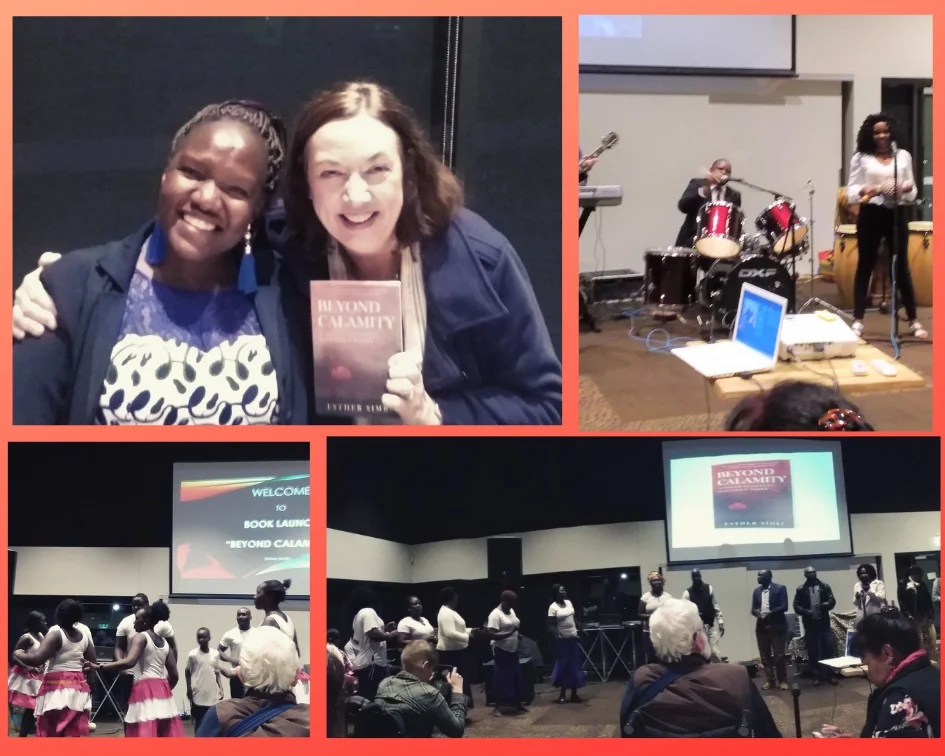
Polio Survivor , Author ,Disability Advocate ,Esther Simbi, & Helen Leach Polio SA
My Journey from Disability and Disaster to Possibility and Empowerment
From writing sums in the dirt with her finger at a poor village school in South Sudan, Esther Simbi rises above disability to become a Social Worker and Disability and Human Rights advocate in Australia.
Giving voice to the voiceless is her passion. She believes that disability is not inability, age is just a number, and ‘refugee’ is just a label.
From polio at age four, through nineteen years in refugee camps in Uganda, Esther’s stories of life in South Sudan and as a refugee will move, shock and inspire you..
Esther Simbi is living proof that disability and disadvantage need not define us. She has overcome incredible odds: losing health, family, home, and community; surviving rape; and living as a refugee for nineteen years. She was the first African woman from a refugee background to run for parliament in South Australia, where she represented people with disabilities. Education, she believes, is the key to empowerment, and she works tirelessly to empower those who do not have a voice, or have not yet found their voice, to lessen inequality and disadvantage.
Vivid Publishing
ABN 91516 588 690
P.O. Box 948, Fremantle
Western Australia 6959
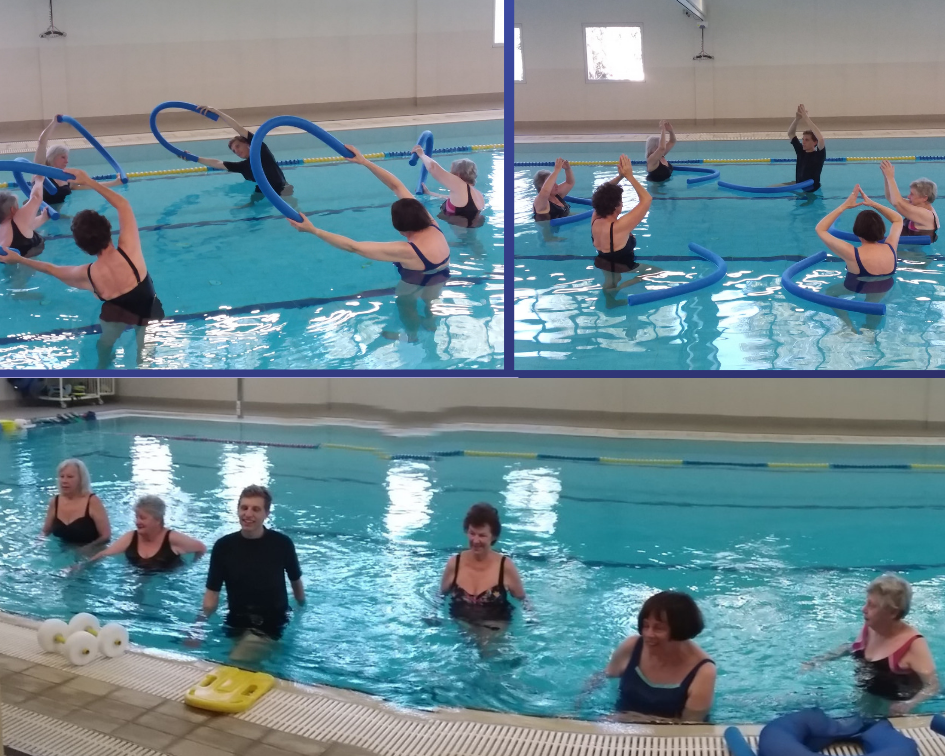
Hydrotherapy at the Repat
A recent Visit to Repat Hydrotherapy session
Polio SA Southern run a fortnightly hydrotherapy group-based exercise class for men and women at the Repatriation hydrotherapy pool every fortnight on Thursday afternoons from 1-2pm. The classes are instructed by a physiotherapist from Unley Physiotherapy and are structured to include a variety of different exercises focusing on balance, muscular strength, core stability and aerobic endurance. The program is flexible, with all exercises able to be modified to suit your ability and ensure you are comfortable and confident in the water. Most of all we like you to have fun, engage with other group members and get the most out of your time in the pool.
Matt - Physio
The facilities at the Repat are top rate and we are so lucky to be able to make use of them. Especially under the direction of our leader Matt. It is good to reacquaint with old friends and also to meet new ones.
Gay - Polio SA Member

Polio SA Members - Physio - Matt at Hydro Session at Repat Hydro Pool
Early 2019 Griffith Rehabilitation Hospital established a specific inpatient rehabilitation program for post polio survivors
A specific inpatient rehabilitation program for post-polo survivors
IN EARLY 2019 GRIFFITH REHABILITATION HOSPITAL ESTABLISHED A SPECIFIC INPATIENT REHABILITATION PROGRAM FOR POST-POLIO SURVIVORS AND THOSE SUFFERING THE LATE EFFECTS OF POLIO. THE PROGRAM HAS BEEN VERY WELL RECEIVED AND WILL BE ONGOING FOR THE FORESEEABLE FUTURE. THE DETAILS ARE OUTLINED BELOW.
ELIGIBILITY
Griffith Rehabilitation Hospital is a Private Hospital and persons wishing to be admitted into the program will need to have Private Hospital health fund coverage. There are usually no out of pocket expenses, however checks are completed for each participant to identify any specific exclusions or co-payment rules that may exist with some funds so people can make an informed financial choice. Please note, Griffith are unable to advise on eligibility/costs with the interactions outside of private health cover (i.e. the NDIS).
A GP referral is required, and Griffith Rehabilitation can guide people through the relatively straightforward admission process.
To be admitted into the program, participants need to be medically stable and be able to participate in a short stay, individualised rehabilitation program. All participants are admitted under a Rehabilitation Physician who will oversee each rehabilitation program.
The program is aimed at people who can complete 30 minutes of rehabilitation over the course of a day. This program is not set up for someone with a respirator but can include people who use of oxygen via a concentrator or cylinder.
PROGRAM COMPONENTS
Those admitted receive an assessment and a program that includes fatigue management, pain management, appropriate reconditioning exercise, hydrotherapy (not compulsory), balance/falls prevention and other services which may become apparent through the initial assessment and goal setting.
The typical length of stay is between 5 to 12 days
All meals are provided on site.
For those persons who are not able to consider an inpatient program, Griffith also runs a Day Rehabilitation service. This is also funded from hospital cover (not extras cover) but does not involve overnight stay. Day Rehabilitation is small group-based rehabilitation and comprises of 2-hour sessions (with a break halfway) that includes a gym-based program as well as hydrotherapy (again, not compulsory). The sessions run twice or three times per week for 6 to 8 weeks
ABOUT GRIFFITH PRIVATE HOSPITAL
Griffith Rehabilitation Hospital has a multi-disciplinary team consisting of:
· Rehabilitation Specialists
· Medical Officers
· Rehabilitation Nurses
· Physiotherapists
· Occupational Therapists
Speech Pathologist
Dietician
Other Allied Health staff are also available (e.g. Exercise Physiologists, Podiatrist, Psychologist) as deemed appropriate by the multidisciplinary team.
The Hospital is a 46 room, 64 bed, Private Rehabilitation Hospital, staffed 24 hours per day, 7 days per week by highly skilled nursing staff. Allied Health rehabilitation staff are onsite from 8.00 am to 4.30 pm (Mon to Fri); approximately 8.30 am to 3.00 pm (Saturday) and similar on Sundays and public holidays.
There are GP’s and Rehabilitation Physicians available at differing times during the week but there are NO staffed after-hours doctors. In the event of a significant medical concern patients are transferred by ambulance to an acute hospital facility for appropriate assessment and care.
Please note, no family members are able to stay overnight at the hospital but there are various Motels, Caravan Park etc nearby. All participants must also have a known discharge destination.
Further information regarding admission to Griffith may be obtained by phoning the hospital on (08) 81794200 and speaking to one of our Rehabilitation Assessment Nurses.
Jeff Millen
Allied Health Director
Griffith Rehabilitation Hospital
Congratulations John Tierney on Queen's Birthday Honours List
Our national patron, John Tierney, was included on the Queen's Birthday Honours List over the weekend.
Our national patron, John Tierney, was included on the Queen's Birthday Honours List over the weekend.
Congratulations John, and thanks for all you do to raise the profile of polio survivors across the country.

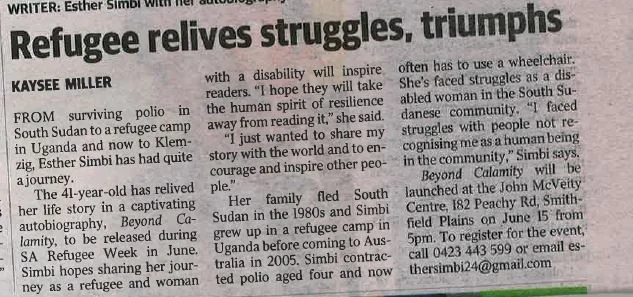
Book Launch Polio Survivor Esther Simbi

Esther Simbi a Polio Survivor from South Sudan is launching a book called Beyond Calamity at an event on 15th June 5pm at John McVeity Centre 182, Peachy Rd Smithfield Plains SA 5114 .
Please see attached image for contact details to attend.
Winter 2019 Newsletter
In this edition
1. From the President
2. A polio survivor? Use those muscles too much and you just MIGHT lose it!
3. Smart people and their thoughts on exercise.
4. The 10 commandments for PPS
5. Where did that virus go in your body?
6. Wonderful people in polio
7. A Polio Survivor Story: Lynda Shaw
8. Subscription renewal form
9. Our Annual General Meeting.
From the President
I don’t need to remind you that the cool season is starting. As a Post Polio, I for one, do not appreciate being cold!
On the front page of our last Newsletter I told you that Mary-ann Liethof would come to South Australia to conduct a Meeting to “Future Proof” Polio SA. This Meeting was a time for all of us on the Committee to assess where Polio SA was going.
The major outcome was to use some of our accumulated investment funds to employ a part-time “Community and Membership Officer”. With help from Tom from CBB and a video link to Mary-ann we interviewed the six “best” applicants and I am very pleased to be able to introduce you all to Helen Leach.
Helen is employed to perform 15 hours of work per week for Polio SA. Helen has spent time at CBB learning how our funding “works” and other administrative tasks to enable smooth operation. Helen also went to Melbourne and spent time with Mary-ann and Stephanie Cantrill to learn how Polio Australia is managed. As you can see Helen has already done a lot to learn how to improve services to Members of Polio SA. There will be more to come. Thank you for your enthusiasm Helen. (Helen introduces herself on Page 6 of this newsletter.)
From what I have heard, the Hydrotherapy sessions at the Repat Pool are very popular and I believe most sessions are now fully attended which is very pleasing.
The Annual General Meeting of Polio SA will be on Sunday 18th August 2019 in the Meeting Room at 302 South Road at 1:00pm (see the official AGM details on Page 9 of this newsletter). We are very fortunate to have Dr. Quadros as our guest speaker to address the group after the “Business” part is over.
Unfortunately, after more than 15 years at the subscription fee of $15 per annum we have had to increase the annual fee to $20 for a single and $25 for Member and Partner and $25 for Professionals. I am sorry to have to do this, but increased printing fees and other miscellaneous costs have meant we need a bit more cash to maintain our services. I know it is trite, but that increase is less than the cost of some cups of coffee!
Brett Howard, President Polio SA bihoward@bigpond.com | 0403 339 814
Exercising common sense when it comes to muscle weakness
Question:
I read that you don't recommend exercise for polio survivors who are getting weaker. But if I stop exercising and do nothing, won't I lose muscle tone, get flabby and become deconditioned and even weaker?
Answer:
You're asking a good question. It's vital that polio survivors understand what the research really says about exercise for newly-weakened muscles and know the definitions of "muscle tone" and "deconditioned."
Question:
I read that you don't recommend exercise for polio survivors who are getting weaker. But if I stop exercising and do nothing, won't I lose muscle tone, get flabby and become deconditioned and even weaker?
Answer:
You're asking a good question but are using buzzwords that Americans hear on infomercials. It's vital that polio survivors understand what the research really says about exercise for newly-weakened muscles and know the definitions of "muscle tone" and "deconditioned."
We never tell polio survivors to "do nothing." Both The Post-Polio Institute and Warm Springs long-term follow-up studies find the same thing: All PPS symptoms, fatigue, pain and muscle weakness, decrease when polio survivors stop exercising and follow The Golden Rule: If anything causes fatigue, weakness or pain, DON'T DO IT! (Or do much less of it.)
Unfortunately, those who recommend strengthening exercise to polio survivors quote from the conclusions of half a dozen small studies of leg muscle strengthening, apparently without having read them critically.
The studies' conclusions say that exercise programs "lead to significant gains in strength."
However, when you look at the responses of individual subjects the "significant gains in strength" are hard to find.
Just over half of the studies’ subjects had an increase in upper leg muscle strength of about 26%. One quarter had no change in strength while 21% actually had a decrease in strength of about 10%. So almost as often as not exercise either had no effect or actually decreased muscle strength.
What's more, only two studies asked whether exercise affected polio survivors' fatigue and their ability to function in their daily lives. In one study, strength increased by 36% but muscle fatigue also increased by 21%. In the other study, although muscle strength increased by 30%, there was no improvement in polio survivors' ability to do daily activities, and muscle fatigue increased as much as 300%!
You have to ask what good comes from any small percentage increase in muscle strength that is not related to improved functional ability and that actually increases muscle fatigue more than strength.
And what of "muscle tone"? Most people think that muscle tone means muscles that are firm and have a nice shape.
Muscle tone actually means that muscle fibers are ready to contract.
Muscle tone is lost when motor neurons are damaged and can't turn on muscle fibers. Loss of tone can happen when polio survivors exercise too much and muscles become weaker when poliovirus-damaged motor neurons fail.
Remember, PPS researcher Alan McComas found that polio survivors who have muscle weakness lose at least 7% of their motor neurons each year.
This is why he concluded that "polio survivors should not engage in fatiguing exercise or activities that further stress metabolically damaged neurons that are already overworking.”
Polio survivors' muscles get smaller and lose tone if they're overused and the motor neurons that turn on the muscle fibers die.
Arms and legs get flabby because of increased fat deposits, not a loss of muscle tone. Exercise does burn fat and at first causes muscles to increase in size.
But polio survivors don't want bigger muscle fibers because they "further stress metabolically damaged neurons that are already overworking."
The best way to prevent flabby arms and legs is to stop overusing and abusing your motor neurons and to follow the higher protein, low fat and lower carb Post-Polio Diet.
And what does "deconditioned" mean?
Many polio survivors believe that there are only two ways to live: overusing and abusing or being a couch potato and becoming "deconditioned."
Deconditioning is something that happens when astronauts live in space or you put someone to bed for weeks, removing the pull of gravity and causing a decrease in blood volume and blood pressure. Deconditioning can only happen if polio survivors never leave the couch, not if they take two daily rest breaks on the couch, take a ninety minute nap, stop strengthening exercising or use a power wheelchair.
However, polio survivors may need to "condition" their hearts, especially if they have had a heart attack.
Cardiopulmonary conditioning" uses exercise to strengthen the heart muscle (which was not affected by polio) and make it work more efficiently. However, there is no benefit to running on a treadmill or riding a bicycle to exercise the heart if you thereby stress and kill off poliovirus-damaged motor neurons.
Some polio survivors can do heart conditioning by using their less affected limbs, usually their arms, in a carefully monitored program of paced and non-fatiguing exercise. But for many this type of exercise doesn't increase heart rate enough to get a conditioning effect and leads to fatigue and muscle weakness so it can't be continued for more than a few sessions.
By Dr. Richard L. Bruno HD, PhD: Director, International Centre for Polio Education postpolioinfo.com
The 10 commandments for treating PPS
After 35 years of searching, archaeologists from The Post-Polio Institute have unearthed the “Commandments“ for treating Post-Polio Sequelae (PPS) . . .
After 35 years of searching, archaeologists from The Post-Polio Institute have unearthed the “Commandments“ for treating Post-Polio Sequelae (PPS) . . .
1) Listen to Yourself!
Polio survivors often turned themselves off from the neck down after having polio. The first step in treating PPS is to listen to yourself, to what you feel, physically and emotionally, when you feel it and why. Our most powerful tool in treating PPS is the daily logs our patients keep that relate activities to their symptoms. However, polio survivors sometimes listen too much, to vitamin salesmen saying some herb or spice will "cure "PPS, to other polio survivors who warn that you will eventually have every possible PPS symptom and to friends and family members (and the voices in their own heads) saying you're lazy and that you must "use it or lose it." Polio survivors need to listen to their own bodies, not to busybodies.
2) Activity is Not Exercise!
Polio survivors believe that if they walk around the block five times a day, spend an hour on the exercise bike and take extra trips up and down stairs that their muscle weakness will go away. The opposite is true: the more you overuse your muscles the more strength you lose. Muscles affected by the poliovirus lost at least 60% of their motor neurons; even limbs you thought were not affected by polio lost about 40%. Most disturbing is that untreated polio survivors with new muscle weakness lose on average 7% of their remaining, poliovirus-damaged motor neurons per year, while survivors with severe weakness can lose up to 50% per year! You need to substitute a "conserve it to preserve it“ lifestyle for the "use it or lose it“ philosophy. Polio survivors need to work smarter, not harder.
3) Brake, Don't Break.
The follow-up study of our patients showed that taking two 15 minutes rest breaks per day - that's doing absolutely nothing for 15 minutes - was the single most effective treatment for PPS symptoms. Another study showed that polio survivors who paced activity -- that is worked and then rested for an equal amount of time -- could do 240% more work than if they pushed straight through. Our patients who took rest breaks, paced activities and conserved energy had up to 22% less pain, weakness and fatigue. But polio survivors who quit or refused therapy had 21% more fatigue and 76% more weakness . For polio survivors, slow and steady wins the race.
4) A Crutch is Not a Crutch . . . . . .
and a brace is not a sign of failure or of "giving up." You use three times less energy (and look better walking) using a short leg brace on a weakened leg. Overworked muscles and joints hurt and nerves die after decades of doing too much work with too few motor neurons. So why not use a brace, cane, crutches (dare I say a wheelchair or a scooter) if they decrease your symptoms and make it possible to finally take that trip to Disney World? I know, you'll slow down and take care of yourself "when you're ready" and use a wheelchair "when there's no other choice." You don't drive your car until it stops because it's out of gas. Why drive your body until it's out of neurons?
5) Just Say "No“ to drugs, unless...
More than a half dozen studies have failed to find any drug that treats PPS. And there have been no studies showing that herbal remedies, electric stimulation or magnets reduce symptoms. Polio survivors shouldn't think that they can run themselves ragged, apply a magnet or pop a pill and their PPS will disappear. Pain, weakness and fatigue are not-so-subtle messages from your body telling you that damage is being done! Masking symptoms -- with magnets or morphine -- will not cure PPS. However, two of our studies have shown that polio survivors are twice as sensitive to pain as everyone else and usually need more pain medication for a longer time after surgery or an injury (see 10 below).
6) Sleep Right All Night.
A significant majority of polio survivors have disturbed sleep due to pain, anxiety or sleep disorders, such sleep apnea (not breathing), hypopneas (shallow breathing) or muscles twitching and jumping all over your body during the night. However, polio survivors are usually not aware that they stop breathing or twitch. You need a sleep study at a sleep disorders center if you awaken at night with your heart pounding, anxiety, shortness of breath, choking, twitching or awaken in the morning with a headache or not feeling rested. "Post-polio fatigue“ may be due to a treatable sleep disorder.
7) Some Polio Survivors Like it Hot.
Polio survivors have cold and purple "polio feet“ because the nerves that control the size of blood vessels were killed by the poliovirus. Polio survivors' nerves and muscles function as if it's 20 degrees colder than the actual outside temperature! Cold is the second most commonly reported cause of muscle weakness and is the easiest to treat. Dress in layers and wear socks made of the silk-like plastic fiber polypropylene that holds in your body heat.
8) Breakfast Is the Most Important Meal of the Day.
For once Mom was right. Many polio survivors eat a Type A diet: no breakfast, coffee for lunch and cold pizza for dinner. Our dietary study showed that the less protein polio survivors have at breakfast the more severe their fatigue and muscle weakness during the day. When our patients follow a hypoglycemia diet (have 16 grams of low-fat protein at breakfast and small, non-carbohydrate snacks throughout the day) they have a remarkable reduction in fatigue. Protein in the morning does stop your mid-day yawning.
9) Do Unto Yourself as You Have Been Doing For Others.
Many polio survivors were verbally abused, slapped and even beaten by therapists or family members when they had polio to "motivate" them to get up and walk. So polio survivors took control, becoming Type A super achievers, "the best and the brightest,” doing everything for everyone...except themselves. Many polio survivors do for others and don't ask for help because they are afraid of being abused again if they even look “disabled.” Isn't it time that you got something back for all you've done for others? Accepting assistance is not the same as being dependent. Accepting assistance can actually keep you independent. But appearing disabled by not doing for others, asking for help or using a scooter, will be frightening.
So please remember: If you don't feel guilty or anxious you are not taking care of yourself and managing your PPS
10) Make Doctors Cooperate Before They Operate.
Polio survivors are easily anesthetized because the part of the brain that keeps them awake was damaged by the poliovirus. Polio survivors also stay anesthetized longer and can have breathing trouble with anesthesia. Even nerve blocks using local anesthetics can cause problems. All polio survivors should have lung function tests before having a general anesthetic. Your complete polio history and any new problems with breathing, sleeping and swallowing should be brought to the attention of your surgeon or dentist - and especially your anesthesiologist - long before you go under the knife. Polio survivors should NEVER agree to having same-day surgery or outpatient tests (even an endoscopy) that require an anesthetic without their doctor 1) Reading the information on polio survivors increased sensitivity to anesthesia and 2) Being prepared to admit them overnight if too much anesthesia is given and the polio survivor is unsafe to leave the hospital.
The Encyclopedia of Polio and Post-Polio Sequelae contains all of Dr. Richard Bruno’s articles, monographs, commentaries and “Bruno Bytes” https://www.papolionetwork.org/encyclopedia.html
The polio virus went everywhere in the body
Why do some polio survivors experience that their "good leg" is getting weaker even though they "didn't have polio" in that leg.
If the poliovirus got into your spinal cord, some motor neurons going to every muscle were damaged or killed.
This was known in the 1940s and comes from Dr. David Bodian's research on monkeys and humans infected with polio.
He found that 96% of motor neurons were damaged by the poliovirus but that at least 60% had to be killed before muscles show any weakness.
So "unaffected limbs" and "non-paralytic" polio survivors could have lost 59% of their motor neurons and not have known since they had no muscle weakness!
This is why you can't "pump up" up your "good" leg or arm through exercise to compensate for muscle weakness on the other side .
It's also why polio survivors so often come in confused when that experience that their "good leg" is getting weaker even though they "didn't have polio" in that leg.
BOTTOM LINE: The poliovirus went everywhere! The Encyclopedia of Polio and Post-Polio Sequelae contains all of Dr. Richard Bruno’s articles, monographs, commentaries and “Bruno Bytes” https://www.papolionetwork.org/encyclopedia.html
| Categories |
| Search by year |
Are you a polio survivor?
Sharing your story can help others. If you would like to share email us.